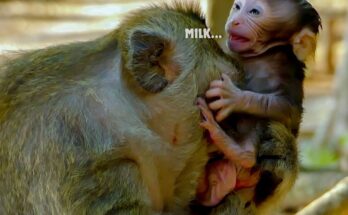
She screamed into the quiet forest.
A cry so raw it seemed to shake the leaves.
And her mother did not turn back.
In the heart of the morning light, April stood firm on a thick branch high above the ground. Her daughter clung to her chest, reaching desperately, searching for comfort, for milk, for the warmth she had always known.
But this time was different.
April pulled away.
The little one’s tiny hands trembled. She tried again, pressing closer, her small fingers gripping tightly into her mother’s fur. A soft whimper turned into a piercing cry that echoed through the trees.
This was the beginning of hard weaning.
For months, the young monkey had depended entirely on her mother’s nursing. It was not just food. It was safety. It was love. It was the world.
Now, that world was shifting.
April’s eyes remained steady. She pushed her daughter aside each time the baby reached to nurse. Not cruelly. Not angrily. But firmly. With intention.
The daughter screamed louder.
Other monkeys paused to watch. The forest felt tense, suspended in a moment of heartbreak. The baby rolled onto the branch, crying in confusion, unable to understand why the one she trusted most was suddenly rejecting her.
For readers who have followed our stories of wildlife parenting challenges, this moment may feel painfully familiar. Like in our recent feature on mother-offspring survival lessons, the journey toward independence often begins with tears.
The conflict grew stronger.
The baby chased April from branch to branch, still begging, still pleading. Each rejection seemed to cut deeper. She clung, she cried, she refused to accept the change.
But April did not give in.
Because this was not rejection born of indifference. It was a survival strategy.
In the wild, prolonged nursing can weaken both mother and child. Independence must come early. Strength must be learned through discomfort. The forest is unforgiving.
Then came the turning point.
Exhausted from crying, the daughter stopped chasing. She sat alone on a lower branch, breathing heavily, her tiny body shaking. For the first time, she looked around — not at her mother — but at the world.
She moved cautiously.
One small step.
Then another.
She reached for leaves. She explored bark. She watched older juveniles forage and imitate their movements. The cries softened into quiet curiosity.
From above, April watched.
Not distant. Not detached. Watching.
In many ways, this mirrors what we explored in our article on natural weaning behavior in wild primates, where tough love becomes the foundation of survival.
By sunset, the baby no longer cried.
She sat independently, chewing leaves she had gathered herself. The forest no longer seemed terrifying — just vast and waiting.
April’s rejection had carved pain into her daughter’s heart. But it had also planted resilience.
Sometimes, the strongest love looks like letting go.
And sometimes, growth begins with tears.
If you were in April’s place, would you have the strength to endure your child’s cries for the sake of her future?