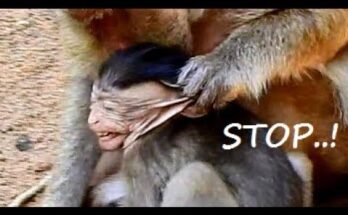
He was shaking.
His tiny hands trembled against the cold ground.
And in his wide, terrified eyes, you could see a silent cry for help.
Solam, a small abandoned monkey, had already known too much fear for such a young life. Separated from protection and comfort, he wandered on the edge of the group — fragile, uncertain, and painfully alone.
In the wild, abandonment is more than loneliness. It is danger.
That morning, tension rose quickly. Boss Gimo, the dominant male known for his unpredictable authority, moved through the area with heavy confidence. His presence alone was enough to silence the younger monkeys.
Solam froze.
You could almost feel his heartbeat through the screen. His breathing grew faster. His body lowered instinctively, trying to disappear into the earth. But fear has a scent — and dominance recognizes weakness.
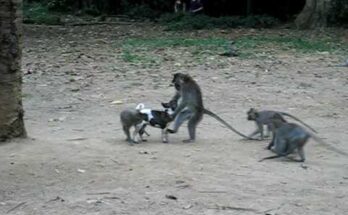
When Gimo suddenly charged toward the VOs, chaos erupted.
Branches shook. Monkeys scattered. Sharp warning calls echoed through the trees.
And Solam panicked.
With nowhere to run and no mother to shield him, his tiny body betrayed his terror. Overwhelmed, he urinated from pure fear — a heartbreaking, involuntary reaction that revealed just how deeply shaken he was.
It was not just a physical response. It was trauma.
For a moment, the scene felt unbearable. An abandoned baby monkey, facing dominance and aggression alone. It’s the kind of raw wildlife reality we often overlook behind beautiful forest images.
But then came a subtle shift.
Gimo’s attention diverted. The chaos moved away from Solam. The tension, slowly, began to dissolve.
Solam remained still, shaking, processing what had just happened. His survival instinct had kept him quiet, submissive, invisible.
And it worked.
In the wild, strength is not always about fighting back. Sometimes, survival means enduring the storm silently.
If you’ve followed our previous story about a young monkey struggling through rejection, you’ll understand how emotional development shapes survival behavior. And similar to the intense dominance patterns explained in our feature on alpha hierarchy conflicts, this moment reveals the harsh structure of monkey society.
Solam’s tears — though unseen — were felt.
This was more than fear. It was a reminder of how vulnerable abandoned wildlife can be when hierarchy and power collide.
Yet he survived.
And survival, in the wilderness, is its own quiet victory.
Watching Solam slowly lift his head again, you can’t help but wonder:
In a world ruled by dominance and instinct, how many silent battles do the smallest creatures fight every single day?