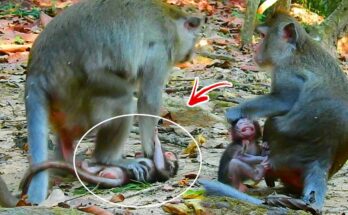
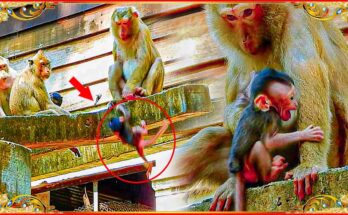
The forest went silent.
Even the wind seemed to hold its breath.
Something dangerous was coming.
In the heart of the jungle clearing, King Balu, Fluffy, and Tomson sensed the shift before anyone else did. The troop had been resting peacefully—young monkeys grooming, mothers nursing, juveniles playfully chasing one another. It was an ordinary afternoon.
Until it wasn’t.
King Balu lifted his head first. His posture changed. Calm turned to command in a single heartbeat. Fluffy froze beside him, eyes scanning the treeline. Tomson moved quietly toward the vulnerable members of the group.
An enemy presence lingered just beyond the shadows.
The younger monkeys felt it too. Play stopped. Tiny hands clutched tightly to their mothers. The air thickened with tension.
King Balu stepped forward.
He didn’t roar. He didn’t panic. He simply stood tall—an unshakable wall between danger and his family. Fluffy positioned herself on higher ground, acting as lookout. Tomson circled the rear, ensuring no surprise attack could scatter the troop.
If you’ve followed our previous story about troop unity during crisis, you already know how quickly chaos can erupt when leadership falters. But this time, leadership stood firm.
The enemy moved closer. Branches snapped. Leaves trembled.
A sudden darting movement from the bushes sent the younger monkeys scrambling. One infant nearly lost grip—but Tomson caught the mother just in time, guiding her toward safer ground. Fluffy signaled sharply from above, confirming the threat’s direction.
King Balu advanced.
It was not reckless aggression. It was controlled dominance. Every step declared: You will not take one of mine.
The standoff lasted seconds—but felt like hours.
Then came the turning point.
Instead of retreating inward, King Balu charged forward just enough to shift the balance of fear. Fluffy descended to flank him. Tomson struck the ground with force, amplifying their presence as a united front.
The message was clear.
This was not a divided troop.
The enemy hesitated. Calculated. And finally withdrew into the forest’s shadows.
Silence returned—but it was different now. It carried relief.
Young monkeys slowly resumed their movement. Mothers exhaled. Grooming began again. But something had changed in the clearing.
Trust had deepened.
If you’ve seen how young members react after danger passes, as we explored in our feature on infant survival instincts, you know these moments shape the future of the troop.
King Balu didn’t celebrate. Leaders rarely do. He simply watched, ensuring every member was accounted for.
Fluffy returned to her perch. Tomson settled near the juveniles.
Protection is not about strength alone. It is about unity. Awareness. Sacrifice.
In the wild, survival depends on those willing to stand first when others must stand behind.
And today, King Balu, Fluffy, and Tomson proved what true leadership looks like.
But here is the deeper question:
When danger approaches your circle, would you step forward—or wait for someone else to protect what matters most?