The baby screamed, but there was nowhere to run.
Held tightly in its mother’s arms, its tiny body trembled.
What looked like cruelty at first glance was something far more complex—and deeply misunderstood.
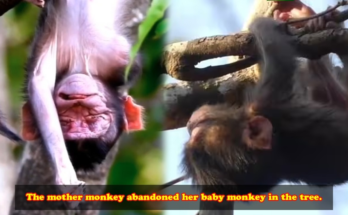
High in the tangled branches, the mother monkey gripped her baby firmly against her chest. The infant squirmed and cried, its fragile voice echoing through the still air. Then, in a shocking moment, the mother lowered her head and began to gnaw gently—but insistently—at the baby’s small leg.
To an outside observer, the act seemed harsh. Disturbing, even.
The baby resisted weakly, its fingers grasping at its mother’s fur, seeking comfort from the very source of its distress. Its cries grew louder, sharper, filled with confusion and fear.
But the mother did not release her hold.
Around them, the troop continued moving, pausing occasionally to glance back. There was no panic among the others, no signs of alarm. This behavior, while uncomfortable to witness, was not entirely unfamiliar within the harsh realities of survival in the wild.
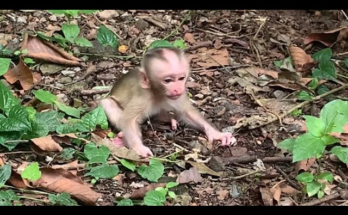
Days earlier, the baby had suffered a minor injury. A fall. A misstep. Its leg had become stiff, possibly infected or irritated. In the wild, there are no medicines, no gentle hands to treat wounds.
Only instinct.
The mother’s actions, though rough, carried purpose. She used her teeth carefully, not to harm, but to inspect, to clean, and perhaps to stimulate circulation in the weakened limb. It was a desperate attempt to heal using the only tools nature had given her.
Moments like this reveal how survival often blurs the line between tenderness and severity. In another documented encounter, we observed [a mother monkey desperately grooming her injured infant to keep it alive], showing that what appears harsh can be driven by protective instinct. Similarly, in [a fragile baby monkey’s struggle after a dangerous fall], maternal intervention played a critical role in recovery.
Still, the baby’s cries pierced the forest.
The turning point came when the infant stopped resisting. Exhausted, it rested against its mother’s chest, its breathing uneven but calm. The mother stopped gnawing and began grooming softly, running her fingers through the baby’s fur in slow, reassuring motions.
The contrast was striking.
Moments earlier, her actions seemed unforgiving. Now, they radiated care and vigilance. She pulled the baby closer, shielding it from the wind, from danger, from everything she could control.
Nature does not operate with human definitions of kindness. It operates with urgency, necessity, and instinct.
What appears cruel may, in truth, be an act of protection.
The baby survived that day. Still fragile, still vulnerable, but alive. And the mother never left its side, carrying it through the forest as both guardian and healer.
This moment leaves us with an uncomfortable but important question—when survival is at stake, how different is love from what we perceive as cruelty, and are we sometimes too quick to misunderstand the language of instinct?