He didn’t understand.
Why was she pulling away?
Why did warmth suddenly feel distant?
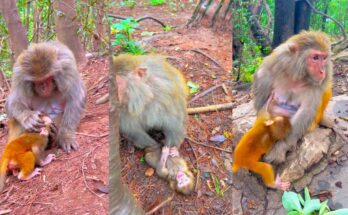
On a quiet morning beneath the trees, Baby Dito clung tightly to his mother’s fur, unaware that his world was about to change. What seemed like an ordinary day in the troop would become one of the most emotional milestones of his young life — the beginning of weaning.
For weeks, Dito had relied completely on his mother. Her presence meant safety. Her touch meant comfort. Her milk meant survival.
But in the wild, even love must evolve.
The first signs were subtle. His mother shifted her body when he tried to nurse. She stood up sooner than usual. She gently nudged him away. To outside observers, these movements seemed small. To Dito, they felt enormous.
Confusion turned into frustration.
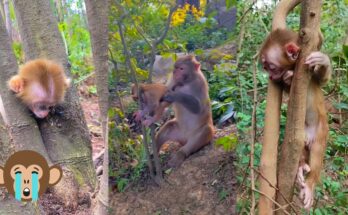
He reached again, desperate for reassurance. A soft cry escaped him. Then another. His tiny hands tugged at her fur, searching for the closeness he had always known.
This is the reality of primate weaning — a natural but painful transition that shapes independence and survival. Like the intense social dynamics we documented in our monkey dominance conflict story, growth in the wild often comes through emotional struggle.
As the morning stretched on, tension built.
Dito’s cries grew louder. Other troop members glanced over, aware but uninvolved. Weaning is not cruelty; it is instinct. A mother must conserve energy, prepare for future offspring, and encourage her young to explore solid food and social bonds.
Still, watching it unfold was heartbreaking.
Then came the turning point.
After another attempt to nurse, his mother firmly stepped aside and climbed onto a low branch. For the first time, Dito was left alone on the ground, staring upward.
He cried — not in anger this time, but in uncertainty.
Minutes passed.
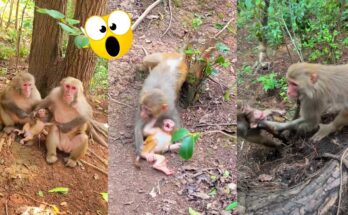
Slowly, something shifted. Instead of following her immediately, Dito turned toward a nearby juvenile. Curious. Hesitant. Exploring.
It was a small step. But it was a step forward.
By the afternoon, he was nibbling leaves, distracted by movement, slowly adapting to the new boundary his mother had set. The distance remained, but so did her watchful gaze. She had not abandoned him. She was teaching him.
Weaning is one of the most emotional transitions in wildlife parenting. It tests attachment, resilience, and instinct. As seen in other emotional wildlife moments captured on our platform, these difficult experiences are essential for long-term survival.
Baby Dito’s tears told a story of loss.
But they also marked the beginning of independence.
In nature, love is not always gentle. Sometimes it is firm. Sometimes it feels harsh. Yet it carries purpose.
As Dito takes his first steps toward self-reliance, one question remains:
When is it time to hold on — and when is it time to let go?